
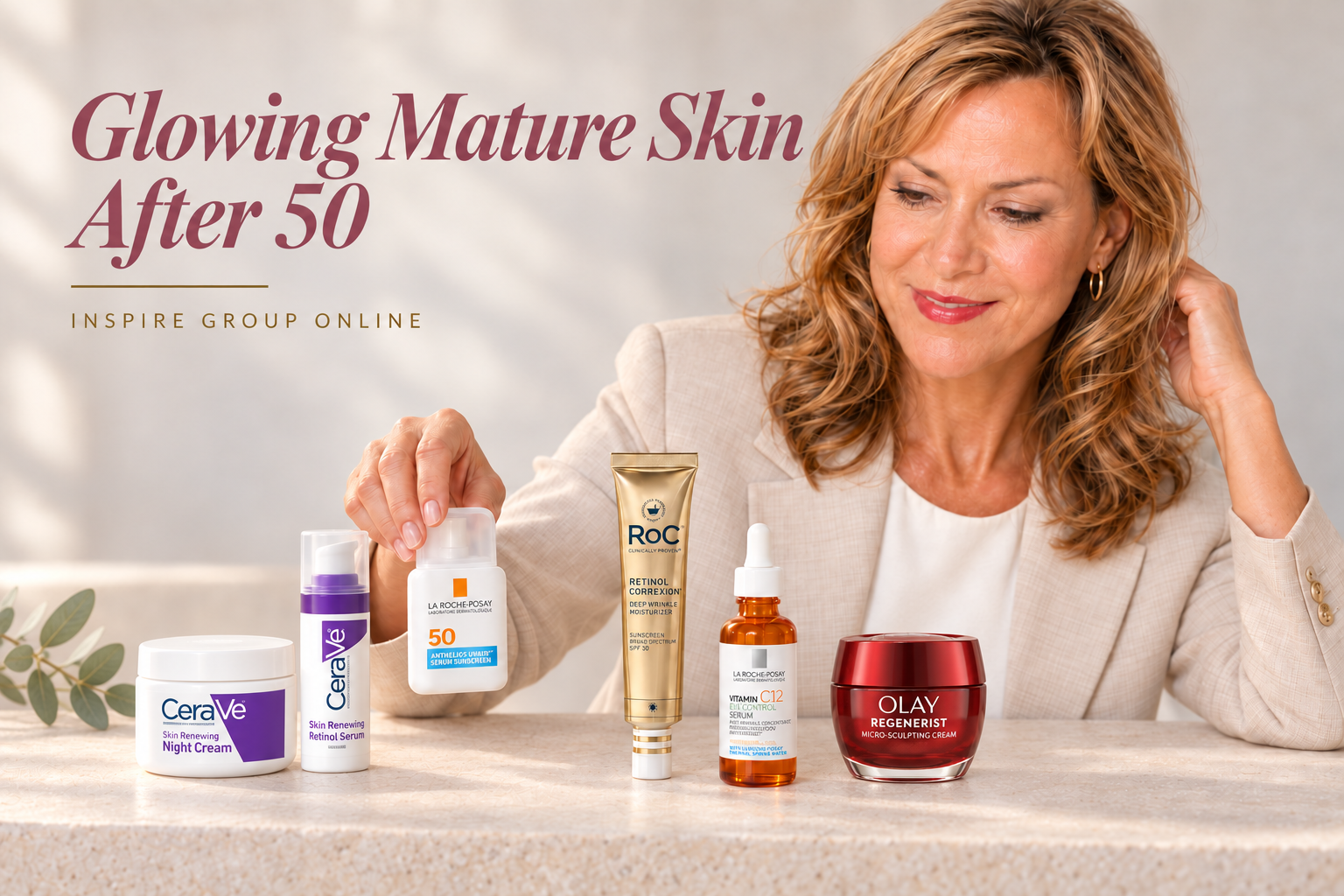
Glowing mature skin does not require a crowded bathroom shelf. After 50, a consistent routine built around gentle cleansing, moisture, daily sun protection and one well-chosen treatment can do more for the look and feel of your skin than a complicated series of products.
The goal is healthy-looking radiance: skin that feels comfortable, looks hydrated and reflects light naturally. Fine lines, uneven tone and texture are normal. A good routine supports the skin you have instead of promising to erase every sign of age.
Confidence looks beautiful at every age. Skin care can support how your skin feels and looks, but it does not define your beauty or your worth.
Skin commonly becomes drier and more easily irritated with age. The American Academy of Dermatology recommends mild cleansing, daily moisturizer and broad-spectrum, water-resistant SPF 30 or higher. It also advises adding one targeted product at a time, because several new active products can irritate skin. [1][2]
Affiliate Disclosure
As an Amazon Associate I earn from qualifying purchases. This article contains affiliate links. If you purchase through one of these links, Amor Posada may earn a commission at no additional cost to you. Product suitability varies, and this content is educational rather than medical advice.
Quick Links to the Six Featured Products
- La Roche-Posay Anthelios UVAir Sunscreen Serum SPF 50
- RoC Retinol Correxion Deep Wrinkle Daily Face Moisturizer
- CeraVe Skin Renewing Retinol Serum
- CeraVe Skin Renewing Night Cream
- Olay Regenerist Micro-Sculpting Cream Fragrance-Free
- La Roche-Posay Vitamin C12 Serum
What Mature Skin Usually Needs Most
A simple routine begins with the basics. Sunscreen helps limit additional UV damage. Moisturizer reduces water loss and can soften the appearance of fine lines. Retinol can improve the look of uneven tone and texture, but it may be too irritating for very dry, inflamed or reactive skin. Vitamin C can support a brighter-looking complexion and add antioxidant support beneath sunscreen. [1][2][3]
You do not need every featured product. The two retinol options overlap, and the two richer moisturizers overlap. Choose the product that fits your skin type, preferences and tolerance. Patch-test when practical and introduce one new active at a time.
Simple Morning Routine for Glowing Mature Skin
Step 1 Cleanse Gently
Use lukewarm water and a mild, fragrance-free cleanser. Skip scrubs and cleansing brushes if they leave your skin tight, red or tender. If your face is comfortable when you wake, a water rinse may be enough for some people; cleansing needs vary.
Step 2 Add Vitamin C If It Suits Your Skin
Vitamin C is optional, not a requirement. Apply it to clean, dry skin before moisturizer and sunscreen. If it stings, causes persistent redness or makes your skin feel drier, use it less often or stop.
Step 3 Moisturize as Needed
A moisturizer helps trap water in the skin. Mature skin often prefers a cream, but texture is personal. Use enough to relieve tightness without forcing a heavy layer that feels uncomfortable under sunscreen.
Step 4 Protect Your Glow With Sunscreen
Finish with a broad-spectrum, water-resistant sunscreen rated SPF 30 or higher. Apply generously before sun exposure and reapply at least every two hours outdoors, as well as after swimming or sweating. Shade, hats and protective clothing add important protection. [1][2]
Simple Evening Routine for Glowing Mature Skin
Step 1 Remove Sunscreen and Cleanse
Cleanse without scrubbing. If makeup or water-resistant sunscreen remains, use a gentle first cleanse followed by a mild facial cleanser. Pat dry rather than rubbing.
Step 2 Use One Retinol Product on Selected Nights
If your skin tolerates retinol, begin slowly according to the product label. A cautious approach is one or two nights per week, then increase only if your skin stays comfortable. Do not layer two retinol products together. Retinoids may not be appropriate during pregnancy, and persistent irritation deserves medical advice. [3]
Step 3 Finish With Moisturizer
Apply a comfortable moisturizer after your treatment, or use moisturizer before and after retinol if your clinician or product directions support that approach. On non-retinol nights, cleansing and moisturizing may be all you need.
Six Products and Where They Fit
La Roche-Posay Anthelios UVAir Sunscreen Serum SPF 50
Routine role: Morning sun protection
This serum-style sunscreen supplies broad-spectrum SPF 50 and is designed for daily facial use. The manufacturer describes an antioxidant-infused formula with an invisible finish. The product should be the final skin care step before makeup. [4]
How to use it: Apply generously 15 minutes before sun exposure. Reapply at least every two hours outdoors and after swimming or sweating.
Good to know: Sunscreen is the foundation of this routine. A pleasant texture matters because the best sunscreen is one you will apply adequately and consistently.
La Roche-Posay Vitamin C12 Serum
Routine role: Optional morning antioxidant step
This 12% pure vitamin C serum is positioned for radiance, uneven-looking tone, fine lines and texture. It also contains salicylic acid, so very dry or reactive skin may prefer less frequent use or a simpler formula. [5]
How to use it: Apply in the morning before moisturizer and sunscreen, following the label. Start several mornings per week if you are cautious.
Good to know: Do not assume tingling means a product is working. Persistent burning, redness or peeling is a reason to stop and reassess.
CeraVe Skin Renewing Retinol Serum
Routine role: Evening treatment option
CeraVe combines encapsulated retinol with hyaluronic acid, niacinamide and ceramides. The manufacturer positions it for fine lines, wrinkles, texture and radiance and recommends gradual introduction. [6]
How to use it: Use at night after cleansing. Begin slowly and follow with moisturizer. Wear sunscreen every morning.
Good to know: Choose this or the RoC retinol product, not both in the same routine.
RoC Retinol Correxion Deep Wrinkle Daily Face Moisturizer
Routine role: Alternative retinol moisturizer
This wrinkle-focused retinol moisturizer offers another way to add retinol. Follow the exact package directions, because product versions and daytime or nighttime labeling can differ.
How to use it: Use only as directed on the current package. If your version contains SPF, it still needs adequate application and reapplication for reliable outdoor protection.
Good to know: Do not stack it with the CeraVe retinol serum. Mature skin that is dry, inflamed or highly sensitive may not tolerate retinol well. [3]
CeraVe Skin Renewing Night Cream
Routine role: Rich evening moisturizer
This fragrance-free cream contains ceramides, hyaluronic acid, niacinamide and peptides. CeraVe describes it as an overnight moisturizer that helps lock in moisture and support the protective skin barrier. [7]
How to use it: Use as the last step at night, including after retinol if your skin needs more cushioning.
Good to know: This may suit women who prefer a richer cream. It is not necessary to use it with the Olay moisturizer.
Olay Regenerist Micro-Sculpting Cream Fragrance-Free
Routine role: Alternative moisturizer for morning or evening
This fragrance-free moisturizer is an alternative for skin that wants lasting hydration and a smoother-looking surface. Product names and formulas can change, so check the current label for ingredients and directions.
How to use it: Apply after serum and before sunscreen in the morning, or use as the final step at night.
Good to know: Choose between this and CeraVe Night Cream based on texture, tolerance and the current ingredient label.
A Simple Weekly Schedule
Morning every day
- Gentle cleanse or rinse
- Vitamin C12 Serum if tolerated
- Moisturizer if needed
- Anthelios UVAir SPF 50, plus reapplication and protective clothing outdoors
Evening on retinol nights
- Gentle cleanse
- One retinol product only: CeraVe Skin Renewing Retinol Serum or RoC Retinol Correxion
- CeraVe Night Cream or Olay Regenerist moisturizer
Evening on recovery nights
- Gentle cleanse
- Moisturizer only
How to Keep the Routine Comfortable
- Add one new treatment at a time and give your skin time to respond.
- Use the product label as the primary instruction for amount, frequency and warnings.
- Reduce frequency when dryness, tightness or mild peeling appears. Stop if irritation is persistent or significant.
- Avoid combining both retinol products or adding strong exfoliating acids on the same night.
- Ask a board-certified dermatologist about changing moles, persistent rashes, severe dryness, rosacea, eczema or a routine that includes prescription treatment.
Frequently Asked Questions
What is the most important product for mature skin after 50
Daily sunscreen and moisturizer form the foundation. The AAD recommends broad-spectrum, water-resistant SPF 30 or higher and regular moisturizer. A targeted treatment can follow once those habits are consistent. [1][2]
Can mature skin use retinol every night
Some skin can gradually tolerate frequent use, but nightly application is not a universal goal. Start slowly, follow the label and reduce frequency if dryness or irritation develops. People with significant dryness, redness or inflammation should ask a dermatologist whether retinol is appropriate. [3]
Should I use vitamin C and retinol together
A simple approach separates them: vitamin C in the morning and retinol on selected evenings. This reduces routine complexity and may make it easier to identify irritation. You do not need to use either ingredient every day to begin.
Do I need both moisturizers in this article
No. CeraVe Skin Renewing Night Cream and Olay Regenerist Micro-Sculpting Cream fill a similar moisturizing role. Choose one based on texture, ingredients, tolerance and budget.
Do I need both retinol products
No. Choose either CeraVe Skin Renewing Retinol Serum or RoC Retinol Correxion. Using two retinol products together increases complexity and may increase irritation without providing a clear advantage.
How long does it take to see more radiant looking skin
Hydration can make skin look smoother fairly quickly, but changes from targeted products usually take longer. The AAD notes that many products need at least six weeks and sometimes up to three months. Consistency and sun protection matter more than rushing. [8]
What if my skin burns or peels
Stop the irritating product and simplify the routine to gentle cleansing, moisturizer and sunscreen. Seek medical advice if the reaction is severe, persistent, swollen, blistered or otherwise concerning.
The Best Routine Is the One Your Skin Can Live With
Glowing mature skin comes from steady care, not a race to use the strongest formula. Protect your skin every morning, keep it comfortably moisturized and choose one treatment for the concern that matters most to you. A routine that feels good is easier to follow, and consistency gives each product a fair chance to help.
Start with sunscreen and moisturizer. Add vitamin C if brightness and uneven-looking tone are priorities. Add one retinol product slowly if texture and fine lines are your main concern and your skin can tolerate it. That is a complete routine. Everything else is optional.
Related Reading From Amor Posada
- Uneven Skin Tone After 50 How I Learned to Exfoliate Without Overdoing It
- How to Wash Oily Skin Without Stripping It Especially After 50
Sources
1. American Academy of Dermatology, Skin care in your 40s and 50s
2. American Academy of Dermatology, How to select skin care products for aging skin
3. American Academy of Dermatology, Retinoid or retinol
4. La Roche-Posay, Anthelios UVAir SPF 50 Serum Sunscreen
5. La Roche-Posay, Vitamin C12 Serum
6. CeraVe, Skin Renewing Retinol Serum
7. CeraVe, Skin Renewing Night Cream
8. American Academy of Dermatology, How to maximize results from skin care products for aging skin
Related Blogs You Might Enjoy:
How to Wash Oily Skin Without Stripping It – Especially After 50
5 Luxury Moisturizers Women Over 50 Are Obsessed With
Medical note: This article provides general education and is not a diagnosis or treatment plan. Product formulas and directions can change. Check the current label and consult a qualified health professional for personal advice, pregnancy-related questions, persistent irritation or a diagnosed skin condition.
Leave a Reply