
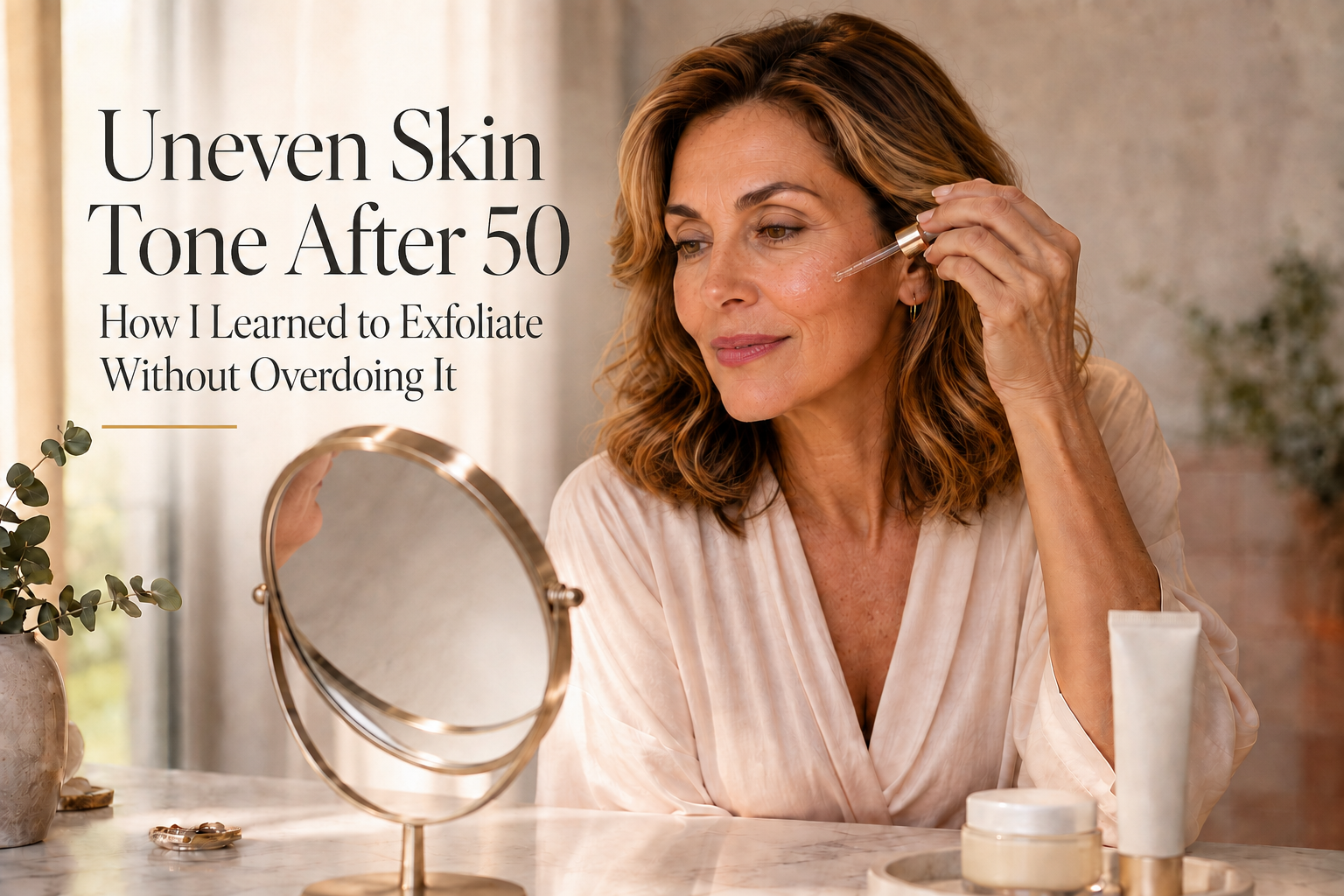
As my skin changed with age, one of the things I noticed most was uneven tone.
I have olive, combination skin, and over the years I became increasingly prone to blotchiness and dark spots. I tried a lot of different skincare approaches, but one of the things that made the biggest visible difference for me was learning how to exfoliate properly.
The important word is properly.
More exfoliation is not necessarily better. In fact, particularly as skin becomes more sensitive with age, repeatedly attacking discoloration with stronger products can leave skin irritated rather than more even-looking.
What finally made sense to me was choosing the right type of exfoliation, using it consistently but moderately, and protecting my skin barrier at the same time.
If uneven tone, dullness or dark spots have become more noticeable after 50, here is the approach I would consider.
Why Skin Can Look More Uneven After 50
Uneven tone can show up in several ways.
You may notice areas that look darker than the rest of your complexion, lingering marks after blemishes or irritation, sun-related discoloration, or simply an overall blotchy appearance that wasn’t as noticeable when you were younger.
That does not mean every dark spot should automatically be treated with a stronger acid.
The first goal is to determine whether gentle-to-moderate exfoliation is appropriate for your skin and then introduce it without disrupting your skin barrier.
For me, a combination of exfoliating acids worked better than repeatedly trying to scrub or aggressively treat individual spots.
What Chemical Exfoliation Actually Does
Chemical exfoliants help loosen and remove older surface skin cells.
Two of the most common categories are:
AHAs — Alpha Hydroxy Acids
These include glycolic, lactic and mandelic acids. AHAs primarily work on the surface of the skin and are commonly used to improve the appearance of dullness, uneven texture and discoloration.
BHAs — Beta Hydroxy Acids
Salicylic acid is the best-known BHA. It is oil soluble, which makes it particularly useful for combination or oilier skin and congested pores.
Some products combine several acids.
That doesn’t automatically make them better. It simply means you have to pay closer attention to your skin’s tolerance.
Three Exfoliation Options for Uneven Skin After 50
These three products take slightly different approaches.
The objective is not to use all three.
Choose the format and acid combination that makes the most sense for your skin.
1 Paula’s Choice 6% Mandelic + 2% Lactic Acid Liquid Exfoliant
Best for: A balanced AHA approach to uneven tone and texture.
Mandelic and lactic acids provide exfoliation without jumping immediately to an extremely aggressive peel.
This is the option I would look at first if your primary concerns are uneven-looking tone, dullness and texture and you want a chemical exfoliant that fits into a controlled skincare routine.
2 CeraVe Skin Renewing Nightly Exfoliating Treatment
Best for: Someone who wants exfoliation while keeping barrier support central to the routine.
This nighttime treatment combines glycolic and lactic acids with ceramides.
That makes it particularly appropriate for the philosophy I follow now: exfoliation should never be separated from barrier care.
You are trying to improve the appearance of the skin—not continually strip it.
3 NassifMD Exfoliating Detox Pads
Best for: Someone already comfortable using exfoliating acids who prefers the convenience of a pad.
These pads use a combination of AHA and BHA exfoliation.
This type of multi-acid formula is closest to what ultimately worked well for my own combination skin, but that does not mean it will be the right choice for everyone.
If your skin is already irritated, sensitive or compromised, I would not treat a stronger multi-acid product as the automatic next step.
Shop NassifMD Detox Pads on Amazon
How Often Should You Exfoliate After 50?
This is where many people get into trouble.
The temptation is to see discoloration and think:
More product + more often = faster results.
Skin does not necessarily work that way.
Start conservatively.
Depending on the product and your skin’s tolerance, that may mean using an exfoliating treatment only a few nights per week rather than automatically using it every evening.
Pay attention to your skin.
If you begin experiencing persistent burning, unusual tightness, redness, peeling or increased sensitivity, that is not a signal to apply more.
It is a signal to reduce your exfoliation and focus on barrier support.
Always follow the product directions, and if pigmentation is persistent, changing rapidly or difficult to identify, consider discussing it with a dermatologist.
Exfoliate Then Moisturize
This is one of the most important changes I made in the way I think about skincare.
Exfoliation is only one step.
My basic routine is:
Cleanser → Treatment/Active → Moisturizer → Sunscreen
At night, after using an exfoliating treatment, follow with a moisturizer appropriate for your skin.
If your skin is already dry, irritated or uncomfortable, it may be better to spend time restoring the barrier before introducing another active.
And Always SPF
If you are working on uneven tone and dark spots, sunscreen belongs in the routine every day—not simply on days when you exfoliate.
One option I like for this campaign is:
La Roche-Posay Anthelios UV Daily Invisible Sunscreen SPF 50
It combines broad-spectrum SPF 50 protection with a lightweight daily facial sunscreen format.
Shop La Roche-Posay SPF 50 on Amazon
Especially when your goal is a more even-looking complexion, it makes very little sense to concentrate on exfoliation while ignoring daily UV protection.
How I Would Choose Between These Products
If I were simplifying the decision:
Choose Paula’s Choice if your main goal is a balanced approach to uneven tone and surface texture.
Choose CeraVe if barrier support is a major concern and you want a nighttime treatment.
Choose NassifMD if you are already accustomed to acids and prefer a convenient multi-acid pad.
You do not need all three.
More skincare is not necessarily better skincare.
My Biggest Lesson About Uneven Skin After 50
I spent a long time trying products because I wanted the blotchiness and dark spots to disappear.
What helped me more was changing the question.
Instead of asking:
“What is the strongest thing I can put on this?”
I started asking:
“What can I use consistently without making my skin angry?”
That is a much better way to approach exfoliation after 50.
The goal isn’t perfectly filtered skin.
The goal is skin that looks healthier, smoother, more comfortable and more even while still looking like your skin.
Shop the Routine
Browse more of my beauty, skincare, wellness and style recommendations on the Amor Posada Amazon Storefront:
You May Also Like
If you are building a practical beauty routine after 50, these related guides can help you care for oily skin gently and explore options for fuller-looking, healthier hair.
How to Wash Oily Skin Without Stripping It – Especially After 50
A gentle cleansing guide for removing excess oil while protecting mature skin’s comfort and moisture barrier.
Best Amazon Products for Thinning Hair After 50: What Helps Hair Look Fuller and Healthier
Explore practical product options designed to help thinning hair look fuller, stronger and healthier after 50.
This article is for general educational purposes and is not medical advice. Individual skin needs vary.
Leave a Reply